How to Tell Whether a Somatic Practice Is Actually Working for You
Quick Answer: Look for changes outside the session rather than inside it. The useful markers are: noticing physical tension earlier in the day than you used to, a shorter gap between stress and recovery, better sleep onset, and a wider vocabulary for what you feel in your body. What is not a good marker is how relaxed you feel during the practice itself, which is largely a measure of the room, the day and the practitioner. Give it eight weeks and track two specific things.
Six weeks in, and you cannot honestly say whether it is doing anything.
That is not necessarily a failure of the practice. It is a failure of what you have been measuring.

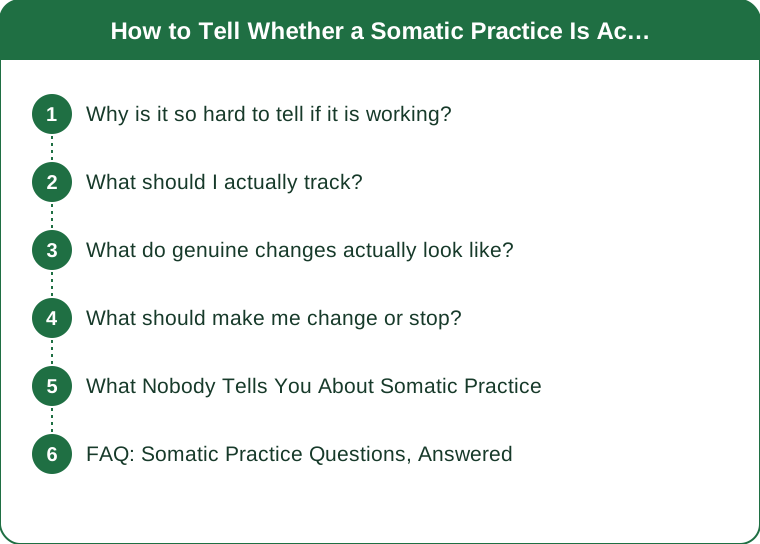
Why is it so hard to tell if it is working?
Because the effects are gradual and the baseline moves with you, so improvement feels like normality rather than change.
The most common marker people use - how relaxed they feel in the session - is the least informative, since it varies with sleep, stress, the room and the practitioner far more than with progress.
Somatic effects are largely about noticing, and noticing more is not an obviously positive experience at first. Many people report becoming aware of tension they did not previously register, which feels like getting worse.
There is no clean number, unlike strength training or running, so people default to a vague sense of whether it is helping.
And the timescale is longer than most people plan for. Eight weeks is a reasonable evaluation window; two is not.
Which is why deciding what to track before you start is worth more than any amount of reflection afterwards. This is general information, not medical advice.
What should I actually track?
Pick two specific, observable things and check them weekly. Two is enough and more becomes a chore you abandon.
Good candidates: time to fall asleep, jaw or shoulder tension at a specific time of day, how long after a stressful event you feel settled, or how often you notice you are holding your breath.
Rate them roughly, not precisely. A one-to-five scale on a Sunday evening is sufficient and takes thirty seconds.
Track the same two for eight weeks rather than changing what you measure when results are unclear.
Note anything else in one line, so you can see whether a bad week was the practice or was a bad week.
And review at week four and week eight, not weekly, since week-to-week noise is large and reviewing too often produces false conclusions.
What do genuine changes actually look like?
Noticing tension earlier. Where you used to realise your shoulders were up at 4pm, you notice at 11am. This is the most commonly reported early change and it is a real one.
A shorter recovery gap. Something stressful happens and you return to baseline in twenty minutes instead of the rest of the afternoon.
More specific vocabulary. Instead of feeling tense, you can locate it and describe its quality, which reflects genuinely increased interoceptive awareness.
Involuntary changes during practice - shifts in breathing, small movements, temperature changes - which many practitioners regard as meaningful signs of nervous system change.
Better sleep onset, which is one of the more commonly reported downstream effects.
And a change in how you respond rather than how you feel, which is the deepest and slowest marker: the same situation producing a different reaction.

What should make me change or stop?
No change in your two tracked markers at eight weeks with consistent practice is a reasonable point to change something - the practitioner, the modality, or the frequency.
Consistently feeling worse afterwards, rather than tired or emotional, which is different.
Distress that persists beyond the session and does not settle, which is worth raising with the practitioner and, if it continues, with a healthcare professional.
Somatic work can surface difficult material, and while some emotional response is commonly described as part of the process, ongoing distress is a signal to seek appropriate support.
A practitioner who cannot explain what they are doing or who discourages questions, which is a reason to look elsewhere.
And practical mismatch - if the format does not fit your life, changing to something shorter and more frequent is usually better than stopping. This is general information, not medical advice.
What Nobody Tells You About Somatic Practice
Feeling worse before feeling better is commonly described, and it makes the first few weeks a poor guide to whether it will help. It is also why people abandon it in week three more often than at any other point.
The evidence base is uneven. Some body-based approaches have meaningful research behind them and others rest largely on practitioner experience and client report. Being clear-eyed about which is which does not require dismissing the practice.
Consistency beats duration by a wide margin. Ten minutes daily produces more of the noticing effect than ninety minutes fortnightly, because the mechanism is largely about repeated attention.
Your baseline changes and you forget the old one. This is the single biggest reason people underrate their own progress, and it is exactly what a written record at week zero prevents.
The practitioner matters a great deal, possibly more than the modality. Fit, trust and communication style influence outcomes substantially across body-based and talking approaches alike.
Time of day changes the experience considerably. The same practice done in the morning and in the evening produces different results for most people, and it is worth trying both before deciding the practice does not suit you.
And seasonal change is a confounder. Starting a practice in autumn, when light is decreasing and mood commonly shifts, means untangling two things at once. Note the season in your record so you can read the results honestly later. This is general information, not medical advice.
FAQ: Somatic Practice Questions, Answered
How long before I should expect changes?
Eight weeks of consistent practice is a reasonable evaluation window. Some people notice small changes in two to three weeks; drawing conclusions before six is usually premature.
How often should I practise?
Short and frequent generally beats long and occasional. Ten to twenty minutes most days is a common recommendation, and consistency matters more than session length.
Is it normal to feel emotional afterwards?
Many people describe emotional responses, and practitioners generally regard this as part of the process. Distress that persists and does not settle is worth raising with your practitioner and, if it continues, with a healthcare professional.
Do I need a practitioner or can I do it alone?
Many practices can be done alone with good guidance. Working with a practitioner helps with technique and is particularly worth considering if you are dealing with trauma or significant health issues.
Is somatic work the same as yoga or stretching?
They overlap but differ in emphasis. Somatic practices generally prioritise internal sensation and nervous system regulation over range of motion or physical form.
What if I feel nothing at all during the practice?
Common early on, and not a sign it is not working. The noticing tends to develop gradually, and the changes outside the session often appear before the in-session experience changes.
When should I see a healthcare professional?
If you have persistent pain, significant mental health concerns, or if the practice consistently produces distress that does not settle. Somatic work is not a substitute for medical or psychological care. This is general information, not medical advice.
TL;DR:
- Judge by what changes outside the session, not by how relaxed you feel during it.
- Pick two specific markers, rate them weekly, and review at weeks four and eight.
- Real early signs: noticing tension earlier in the day, and recovering faster after stress.
- Feeling worse in the first weeks is commonly described and is a poor guide to outcome.
- Consistency beats duration - ten minutes daily outperforms ninety minutes fortnightly.
- Write down your baseline, because you will forget it and underrate your own progress.
Decide what you are measuring before you start, or eight weeks later you still will not know. This is general information, not medical advice.
Keep Reading
This article is for general informational purposes only and is not medical advice. Always consult a qualified health professional for guidance specific to you.