Why Somatic Practice Works Better With Your Eyes Open for Some People
Quick Answer: Closing your eyes removes visual input, which amplifies internal sensation — helpful if you are trying to notice subtle body signals, unhelpful if the amplification includes anxiety, dizziness or a loss of orientation. Eyes-open practice keeps you anchored in the room, which for some people is the difference between a practice that settles the nervous system and one that activates it. Neither is more advanced. They suit different people and different days.
If guided practices consistently make you feel worse, this is one of the first variables to change.
And it is one almost nobody suggests, because the instruction is so standard nobody questions it.

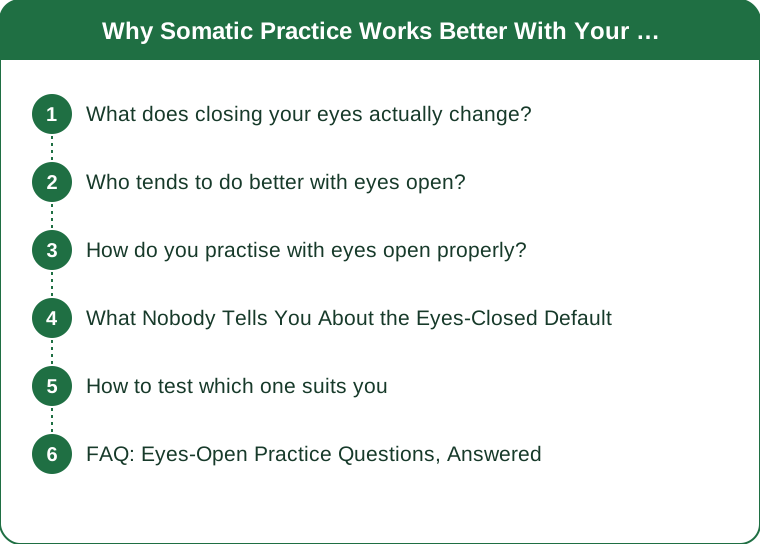
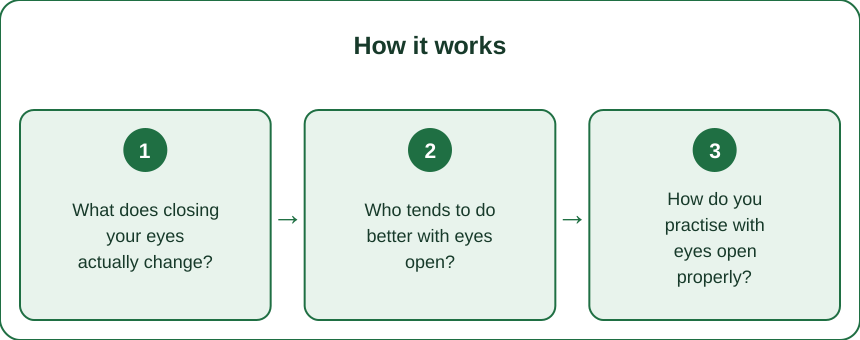
What does closing your eyes actually change?
It reallocates attention, and it removes an anchor.
Vision occupies an enormous share of ordinary attention. Close your eyes and that capacity does not vanish — it goes somewhere, and in a body-focused practice it goes inward. This is precisely why the instruction exists: internal sensations that were below the threshold of notice become noticeable.
For many people that is exactly the intended effect, and eyes-closed practice is deeper as a result.
But two other things happen at the same time:
You lose your spatial anchor. Vision is a major contributor to knowing where you are and which way is up. Removing it increases reliance on the inner ear and on body sense, and for anyone whose balance or orientation is at all uncertain, that can produce a low-grade unease that has nothing to do with the practice content.
You lose environmental confirmation of safety. With eyes open, your nervous system is receiving continuous evidence that the room is fine. With them closed, that evidence stops, and the system has to rely on assumption. For most people this is trivial. For someone whose threat detection runs sensitive, it is not.
So eyes closed amplifies whatever is there. If what is there is subtle sensation, you get depth. If what is there is unease, you get more unease.
Who tends to do better with eyes open?
Several groups, and the overlap between them is large.
People who feel more anxious during meditation rather than less. This is a documented and reasonably common experience, and eyes-open practice is one of the standard adjustments for it.
People with a trauma history. Trauma-informed practice frequently offers eyes-open as a default rather than as an accommodation, precisely because losing environmental awareness can be activating. If closing your eyes produces a feeling of vulnerability, that is meaningful information and it is worth respecting rather than pushing through.
People who get dizzy or unsteady. Anyone with vestibular sensitivity, low blood pressure, or a tendency towards lightheadedness. Removing the visual anchor genuinely makes balance harder.
People who fall asleep. Extremely common with lying-down eyes-closed practice, and eyes-open essentially solves it.
People who dissociate or drift. If eyes-closed practice tends to end with you somewhere else entirely and no memory of the intervening ten minutes, keeping a visual anchor keeps you present.
People practising in an unfamiliar or shared space. A class, a hotel room, an office. Environmental unfamiliarity raises the cost of closing your eyes and it is entirely reasonable not to.
If you are in any of these groups and have concluded that somatic practice does not work for you, it is genuinely worth retesting with your eyes open before accepting that conclusion.
How do you practise with eyes open properly?
It is not simply the same practice with the eyelids up. There is a technique to it.
Use a soft, downward gaze. Roughly a metre or two in front of you, angled down at about 45 degrees. Not focused on anything, not scanning. This is the traditional approach in several contemplative practices for good reason — it keeps the visual anchor without giving your attention a job.
Let the gaze go slightly out of focus. Deliberately unfocusing reduces the visual processing load considerably while keeping the orientation.
Choose a plain surface. A blank patch of floor, a wall, a rug. A cluttered or moving visual field pulls attention outward and defeats the purpose.
Blink normally. Trying not to blink turns it into a staring exercise, which is fatiguing and creates its own tension.
Position matters more than usual. Sitting works better than lying down for eyes-open practice, simply because lying on your back gives you a ceiling to stare at, which is a poor visual anchor.
Expect it to feel less deep initially. With less internal amplification, sensations are quieter. This is not a failure — it is the trade you are making, and for the people this suits, a quieter practice you can actually stay in beats a deeper one you have to abandon.
A middle option worth knowing: eyes half-closed, lids lowered but not shut. It preserves some visual anchoring with much less input, and a lot of people find it is the setting that works for them.
What Nobody Tells You About the Eyes-Closed Default
It is a convention, not a requirement. Several established contemplative traditions practise with eyes open as standard. The near-universal eyes-closed instruction in modern guided audio has more to do with the format — you cannot follow a video with your eyes shut, and audio assumes stillness — than with what works best.
Guided audio makes it worse for some people. A voice in your ears with your eyes closed removes both visual and auditory environmental information at once. If you find guided practice harder than silent practice, this stacking may be why, and practising in silence with eyes open reverses both.
Feeling nothing is not the same as it not working. Eyes-open practice produces quieter sensations, and people trained on the amplified eyes-closed version often read that as failure. Judge by how you feel an hour later, not by the intensity during.
The right choice changes day to day. After a bad night, in an unfamiliar place, or on an anxious day, eyes-open may suit you when eyes-closed usually does. Treating it as a fixed personal setting is unnecessarily rigid.
Some practices genuinely need eyes closed. Anything working with visual imagery or with fine internal discrimination is harder with a visual field competing for attention. This is a real trade rather than a free choice.
Nobody in the room can tell. This is worth saying because it stops people trying it in a class — in any group setting, with a soft downward gaze, nobody knows and nobody is looking, and there is no version of this where you are doing it visibly wrong.
How to test which one suits you
A simple protocol over two weeks, because single sessions vary too much to tell you anything.
Week one: alternate. Same practice, same time of day, same duration, same place. Odd days eyes closed, even days eyes open with a soft downward gaze. Ten minutes is plenty.
Record two numbers after each session. How settled you felt during, 1 to 10, and how settled you feel thirty minutes afterwards, 1 to 10. The second number matters more and almost nobody tracks it.
Also note anything specific. Dizziness, drifting, falling asleep, restlessness, wanting to stop early. Patterns show up quickly in these notes.
Week two: run the winner every day, and see whether the effect holds when it is not alternating.
What the results tend to look like: most people find a clear preference within about six sessions, and a meaningful minority find eyes-open scores better on the thirty-minutes-later number even when eyes-closed felt deeper at the time. That combination — felt less, worked better — is the one worth watching for, because it is the one people talk themselves out of.
A few practical notes. Room temperature matters more than people expect for eyes-open practice, since you are more aware of the environment; a cool room reads as less comfortable with your eyes open than with them shut. And if you practise in the evening, the lower autumn light levels change the visual field considerably — a lamp on a low setting gives a better anchor than a dim room.
If somatic or meditative practice consistently produces distress, intrusive memories or significant anxiety, that is worth working through with a trauma-informed practitioner or a mental health professional rather than adjusting alone. This is general information, not clinical advice.
FAQ: Eyes-Open Practice Questions, Answered
Is eyes-open practice less effective?
No — it is less amplified. For the outcome most people are after, which is a more settled nervous system, the one you can stay in comfortably is the effective one.
What if the guided audio tells me to close my eyes?
Ignore that instruction and follow the rest. No part of a body scan or a somatic sequence depends on eyelid position, and a good practitioner would offer the option anyway.
Should I look at something specific?
No — a plain surface and a soft unfocused gaze. Looking at something specific gives your attention a task, which pulls it outward and away from what you are doing.
Can I use eyes-open practice for sleep?
Not really, since the whole point of a sleep-oriented practice is to let you drop off. If you are using somatic work for sleep, eyes closed is correct and falling asleep is the intended outcome rather than a failure.
Why do I feel dizzy with my eyes closed?
Because balance relies partly on vision and removing it increases the demand on your inner ear. Common, usually benign, and much reduced by sitting rather than standing. Persistent or severe dizziness is worth having checked medically.
Is half-closed a legitimate option or a compromise?
Entirely legitimate, and it is the standard in several long-established practice traditions. For many people it is the setting that works best, keeping some anchoring with much less visual input.
TL;DR:
- Closing your eyes amplifies internal sensation and removes your spatial and environmental anchor
- Eyes-open suits people who get anxious, dizzy, drowsy or drifty during eyes-closed practice
- Use a soft, unfocused, downward gaze on a plain surface, sitting rather than lying down
- Expect it to feel less intense — judge by how you feel thirty minutes later, not during
- The eyes-closed default is a convention of guided audio, not a requirement of the practice
Run the alternating test for a week and record how settled you feel half an hour after each session. If you have written off somatic practice as something that does not work for you, this is the variable most worth changing before you accept that.
Keep Reading
This article is for general informational purposes only and is not medical advice. Always consult a qualified health professional for guidance specific to you.