Why Body Scan Meditation 'Doesn't Work' for You (It's Usually the Order, Not the Practice)
Quick Answer: Body scans commonly ‘fail’ for one of two opposite reasons — falling asleep (usually from lying down too soon or going too slow) or increased anxiety (usually from starting at a tense area first) — switching your starting point and pace fixes most cases within a few tries.
Body scans are recommended constantly for stress and sleep, and yet plenty of people try one and either doze off in the first two minutes or end up more wound up than before. Both outcomes usually trace back to a fixable mechanical issue, not a personal failure at meditating.

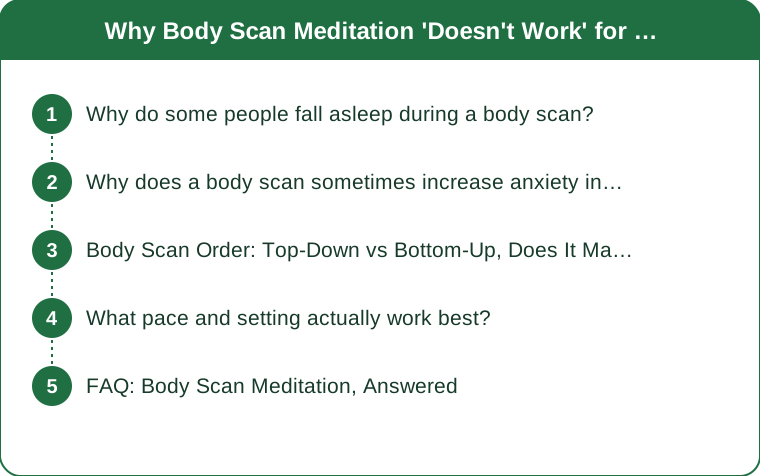
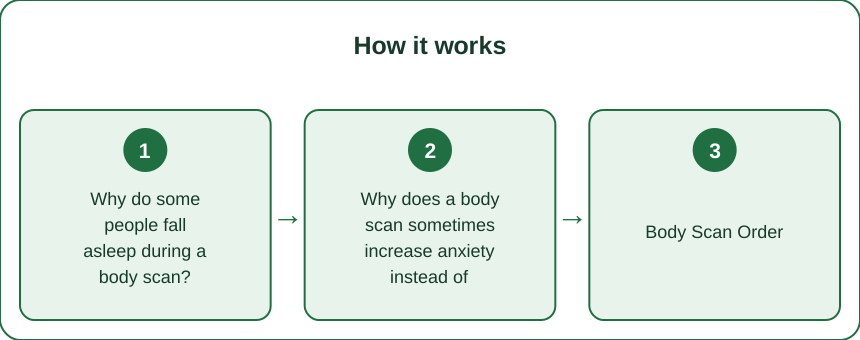
Why do some people fall asleep during a body scan?
Lying flat combined with a slow, monotone guided voice mimics the exact conditions used to fall asleep, so for people already tired, sleep readiness beats meditative awareness almost every time.
This isn’t necessarily a problem if the goal is sleep — but if the goal is a waking relaxation practice, doing it seated or with eyes slightly open changes the outcome significantly.
Why does a body scan sometimes increase anxiety instead of reducing it?
Starting the scan at an area that’s already tense or in pain forces early, sustained attention onto discomfort before you’ve built any relaxation momentum, which can amplify the sensation rather than ease it.
Many scripts default to starting at the toes and working up, which is arbitrary — starting instead at a neutral, comfortable area (often the hands or face) and moving toward tense areas last tends to work better for anxiety-prone practitioners.

Body Scan Order: Top-Down vs Bottom-Up, Does It Matter?
Bottom-up (toes to head) is the traditional default, but top-down or ‘neutral area first’ ordering is equally valid and often better tolerated by people who carry tension in their lower body (feet, legs) specifically.
There’s no single correct order — the practical guidance is to start wherever feels most neutral in your body that day, and treat the specific sequence as adjustable rather than fixed.
What pace and setting actually work best?
A moderately paced scan (10-15 minutes total, roughly 30-45 seconds per body area) tends to hold attention better than either a very fast pass or an extremely slow one, which can lose people to boredom or sleep respectively.
Doing it seated with eyes open or softly focused, especially earlier in the day, keeps the practice in ‘awareness’ mode rather than sliding into sleep — reserve the lying-down, slow version specifically for bedtime use.
FAQ: Body Scan Meditation, Answered
Is it bad if I fall asleep during a body scan?
Not if you’re doing it at bedtime intentionally — in that context, falling asleep is a success, not a failure of the practice.
How long should a body scan be for a beginner?
10-15 minutes is a reasonable starting length — very long scans (30+ minutes) are harder to sustain attention through for beginners and can increase frustration.
Can a body scan make chronic pain feel worse?
For some people, sustained attention on a painful area can temporarily increase perceived intensity — starting elsewhere and approaching the painful area last, briefly, tends to reduce this effect. If pain is severe, check with a professional about whether this practice is appropriate for you.
TL;DR:
- Falling asleep usually means lying down too early or too slow a pace for a waking practice
- Anxiety spikes usually come from starting the scan at an already-tense area
- Order (top-down vs bottom-up) is flexible — start wherever feels neutral
- Seated with eyes open works better for daytime awareness than the bedtime version
Try a seated, neutral-start version next time before deciding body scans ‘don’t work’ for you. This is general information, not medical advice.
Keep Reading
This article is for general informational purposes only and is not medical advice. Always consult a qualified health professional for guidance specific to you.