Does Somatic Work Actually 'Release Trauma,' or Is That Claim Overstated?
Quick Answer: Somatic practices do have real, evidence-supported benefits for regulating the nervous system’s stress response, which can meaningfully help trauma-related symptoms, but the specific claim that trauma is literally ‘stored’ in tissue and mechanically ‘released’ through movement is a more contested, less scientifically established framing than the practical stress-regulation benefits themselves.

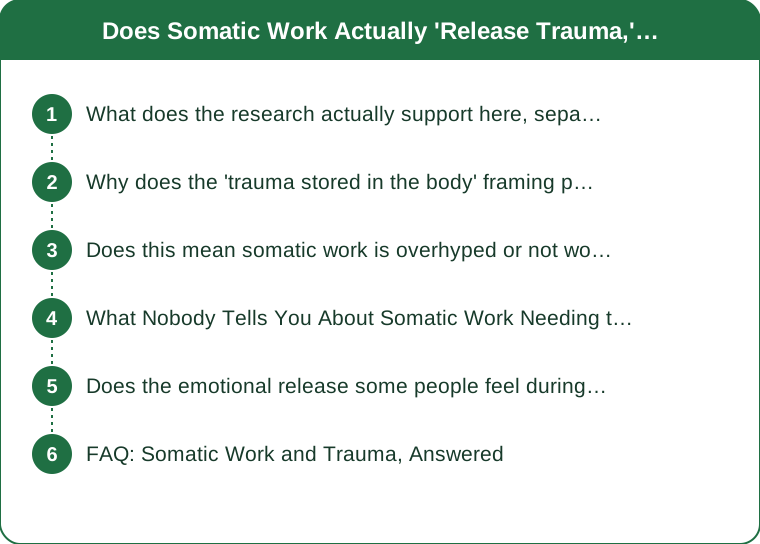
What does the research actually support here, separate from the popular framing?
Research more consistently supports somatic practices’ effect on nervous system regulation — reducing sympathetic nervous system activation and supporting parasympathetic, calming responses — than it supports the literal claim that trauma is stored in muscle tissue and released through specific movements; the regulation mechanism is well-documented, while the storage-and-release framing is more of a therapeutic metaphor than an established physiological mechanism.
Why does the ‘trauma stored in the body’ framing persist if it’s not fully established?
The framing captures something real that many people experience — physical sensations connected to emotional or traumatic memory — even if the precise mechanism isn’t ‘storage’ in muscle tissue the way the metaphor implies; the felt experience of a physical release during somatic work is genuine for many people, even though the underlying explanation is more likely nervous system regulation and associative memory processing than literal physical storage.
Does this mean somatic work is overhyped or not worth doing?
No — the nervous system regulation benefits alone are legitimate and meaningful, supporting reduced anxiety, improved stress response, and better emotional regulation for many people, including those with trauma histories; the practice doesn’t need the more contested ‘stored trauma release’ framing to be worthwhile, since the more modest, better-supported framing already justifies its use.

What Nobody Tells You About Somatic Work Needing to Be Paired With Other Trauma Treatment
For significant trauma, somatic practices are generally considered a valuable complement to, not a replacement for, evidence-based trauma therapies (like EMDR or trauma-focused CBT) — treating somatic movement as a standalone trauma treatment, rather than a supportive practice alongside professional trauma-specific therapy, oversells what the current evidence actually supports for serious trauma processing.
Does the emotional release some people feel during somatic work indicate something is ‘unstuck’ happening in a real medical sense?
The felt experience of release is real and valid as a subjective experience, but it’s more accurately understood as a nervous system shift (moving out of a sympathetic, activated stress state into a calmer parasympathetic state) combined with associative emotional processing, rather than direct evidence of literal trauma being physically dislodged from tissue — the experience matters and can be genuinely therapeutic without the more literal mechanistic explanation being accurate.
FAQ: Somatic Work and Trauma, Answered
Is somatic work safe for people with significant trauma histories to try without a therapist?
Gentle, well-established practices are generally considered low-risk, though working with a trauma-informed practitioner is recommended for anyone with significant trauma history, since some somatic work can bring up intense emotions that benefit from professional support.
Does the research distinguish between different types of somatic practice (yoga, shaking, breathwork)?
Some research does look at specific modalities separately, with body-based yoga and certain breathwork practices having somewhat more research behind their nervous system effects than newer or less-studied somatic techniques.
Should someone stop somatic work if they don’t feel a dramatic ‘release’ experience?
No — the absence of a dramatic release doesn’t mean the practice isn’t providing nervous system regulation benefit; not everyone experiences or needs a dramatic emotional release for the practice to be worthwhile.
TL;DR:
- Nervous system regulation is the well-supported mechanism behind somatic work’s benefits
- The literal ‘trauma stored in tissue and released’ framing is more metaphor than established science
- The practice remains legitimately valuable without needing the more contested framing to justify it
- For significant trauma, it works best paired with, not instead of, evidence-based trauma therapy
The felt experience of release is real — the more accurate explanation is nervous system shift, not literal tissue storage.
Keep Reading
This article is for general informational purposes only and is not medical advice. Always consult a qualified health professional for guidance specific to you.