If Body Scan Meditation 'Doesn't Work' for You, Try This Fix First
Quick Answer: Feeling nothing during a body scan usually means you’re scanning too fast or expecting a strong sensation instead of noticing subtle or neutral ones. Slowing down to 60-90 seconds per body part, and accepting “neutral” as a valid finding, fixes most stuck body scans.
“I just feel nothing” is one of the most common body scan complaints, and it almost always traces back to the same mismatch between expectation and what the practice actually asks of you.

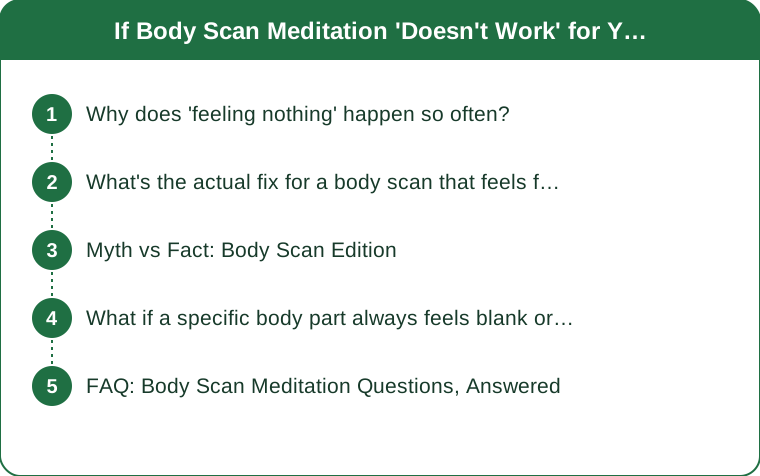
Why does ‘feeling nothing’ happen so often?
Most people expect body scan to produce dramatic sensations — tingling, warmth, obvious release — and when a body part just feels neutral or ordinary, they interpret that as doing it wrong. But neutral is a completely valid observation, not a failure state. The skill being built is attention itself, not the production of sensation.
What’s the actual fix for a body scan that feels flat?
Slow down significantly — most beginners rush through each body part in 10-15 seconds, which isn’t long enough for subtler sensations to register. Spending a full 60-90 seconds per area, even when nothing seems to be happening, gives your attention time to actually settle rather than skim.

Myth vs Fact: Body Scan Edition
Myth: You should feel something specific in every body part. Fact: Neutral, numb, or “can’t quite locate that area” are all normal, useful observations — the practice is about noticing whatever is actually there, not manufacturing sensation.
Myth: If your mind wanders, you failed the body scan. Fact: Noticing that your mind wandered and gently returning attention is the practice — it’s not a sign of failure, it’s the actual mechanism the practice trains.
Myth: Body scan should feel relaxing every time. Fact: Some sessions surface tension, restlessness, or discomfort instead of calm — that’s useful information about your current state, not a sign the technique isn’t working for you.
What if a specific body part always feels blank or hard to locate?
This is common, especially in areas connected to old injury, chronic tension, or simply less everyday attention (many people report this with the back or feet). Spending slightly longer there, and being curious rather than frustrated about the blankness, often produces more clarity over repeated sessions than forcing an answer in one sitting.
FAQ: Body Scan Meditation Questions, Answered
How long should a beginner body scan take?
15-20 minutes for a full-body scan is a reasonable beginner length — much shorter and there isn’t time to slow down enough per area to notice subtler sensations.
Is it normal to fall asleep during a body scan?
Very common, especially lying down — it’s not a failure, though sitting upright or scanning earlier in the day can help if you specifically want to stay awake for the practice.
Why do I feel more tense after a body scan, not less?
Sometimes attention surfaces tension you’d been unconsciously holding and ignoring — noticing it is the first useful step, even though it can feel counterintuitive in the moment.
TL;DR:
- Feeling nothing usually means going too fast, not doing it wrong
- Slow to 60-90 seconds per body part and accept neutral as a valid finding
- Mind-wandering and returning attention is the actual practice, not a failure
- A consistently blank area often clears up over repeated sessions, not one
Body scan isn’t about producing sensation on demand — it’s about noticing whatever is actually there, including nothing.
Keep Reading
This article is for general informational purposes only and is not medical advice. Always consult a qualified health professional for guidance specific to you.