How Long Should a Somatic Session Actually Be?
Quick Answer: Shorter than you think. Five to fifteen minutes is the effective range for a daily practice, and consistency at that length beats a weekly 45-minute session by a wide margin. Nervous system regulation responds to frequency of repetition, not duration of exposure — you are teaching a pattern, not accumulating hours. Longer sessions of 30 to 60 minutes have a place, but as an occasional practice rather than the standard.
You read that somatic work requires patience and stillness, so you set aside 45 minutes, managed it twice, and then stopped.
That was not a discipline failure. It was a dosing error — the length people aim for comes from class formats and guided recordings, neither of which is designed around what actually builds the capacity. The third section explains why the short version works better, and it is not the reason most people assume.
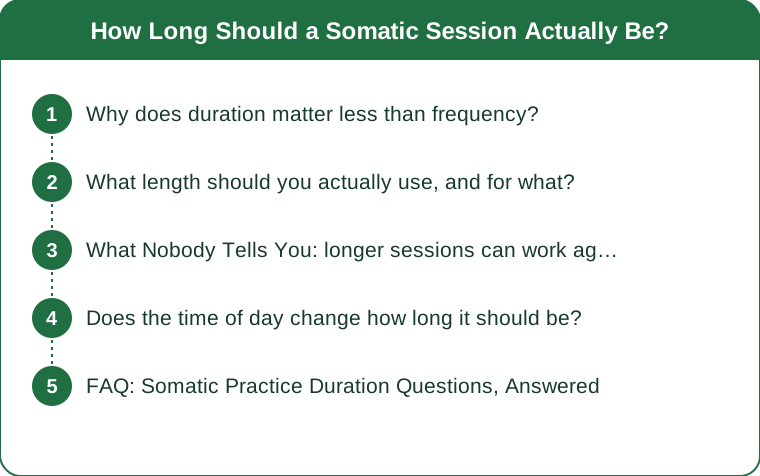
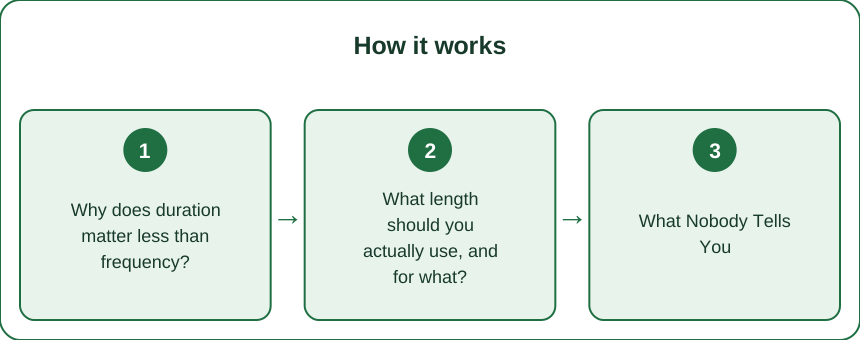
Why does duration matter less than frequency?
Because of what you are actually training.
Somatic practice is teaching your nervous system to recognize and shift its own state — to notice tension, to notice arousal, and to be able to move down from it. That is a learned capacity, and learned capacities are built by repetition across time, not by extended single exposures.
The comparison that makes it obvious: you would not learn a language by studying for four hours once a week. Twenty minutes daily beats it comprehensively, and everyone accepts this. The same logic applies here and almost nobody applies it.
There is a physiological angle too. The shift from a sympathetic to a parasympathetic state can begin within a couple of minutes of slow breathing or deliberate attention to the body. You do not need 40 minutes to access it; you need to access it often enough that the pathway gets easier to find.
The practical implication is significant. Once you know that a five-minute practice counts, the practice stops competing with your schedule. It fits in before a meeting, in a parked car, or on the floor while dinner is cooking — and the version that fits is the version that continues.
The single strongest predictor of whether somatic work does anything for someone is how many weeks they keep doing it, not how long each session runs.
What length should you actually use, and for what?
2 to 5 minutes: the reset
For interrupting a state. Overwhelm mid-day, anxiety before something difficult, the transition from work to home. A few rounds of extended exhale breathing, some shaking, or a quick scan of three body regions.
This is the most-used and least-respected duration. A 3-minute reset done four times a day builds the pathway faster than a 30-minute session done twice a week, because you are practicing the shift itself repeatedly.
10 to 15 minutes: the daily practice
This is the sweet spot for a standing daily practice. Long enough for a full body scan or a sequence of somatic movements, short enough to actually happen on a bad day.
Structure that works: two minutes settling, eight to ten minutes of the practice itself, two minutes of rest afterwards — that last part being the piece people cut and the piece where the integration happens.
30 to 60 minutes: the occasional deep session
Once a week, or when you have the space. Longer sessions allow slower, more exploratory work and are where more layered material tends to surface.
They are not a better version of the daily practice — they are a different thing. Treating them as the standard is what causes people to quit, because a practice that requires an hour requires a life that reliably has an hour in it.
A realistic weekly shape
Ten to fifteen minutes on most days, a few 2-minute resets as needed, and one longer session when it fits. That is a sustainable practice, and it will do considerably more over three months than an ambitious schedule abandoned in week two.

What Nobody Tells You: longer sessions can work against you
Here is the part that runs against the general assumption that more is better.
Extended somatic work can move faster than your capacity to integrate it. When attention stays with the body for a long time, particularly for people carrying stored tension or difficult history, the practice can move from settling into activating — and it is not always obvious in the moment which is happening.
Signs you have gone past your window in a session: agitation that builds rather than settles, a sense of being flooded, increasing anxiety rather than decreasing, dissociation or feeling far away, or a strong urge to stop that you are overriding.
The instruction that matters here: when that happens, stop. Open your eyes, sit up, look around the room, feel your feet, name a few objects. Coming out early is a skill, not a failure, and pushing through it is the main way somatic practice becomes unpleasant enough to abandon.
This is why short sessions are the safer default, especially early on. Ten minutes stays comfortably inside most people’s window. Forty-five minutes, particularly unguided, does not reliably.
Titration is the actual principle — small doses, allowed to settle, repeated. It is the foundation of how this work is taught professionally, and it is the part that gets lost when the practice migrates to an app with a 45-minute track on it.
If somatic work consistently brings up significant distress, overwhelming emotion, or trauma responses, that is a signal to work with a trained somatic practitioner or therapist rather than continuing alone. This is general information, not therapeutic advice.
Does the time of day change how long it should be?
Somewhat, and matching the two makes the practice much easier to keep.
Morning practice runs shorter. Five to ten minutes, oriented toward waking the body rather than deeply settling it — gentle movement, breath, orientation to the room. Long morning sessions compete directly with everything else and lose.
Midday is reset territory. Two to five minutes, purely functional, no setup required.
Evening tolerates the longest sessions. Fifteen to thirty minutes, and this is where a body scan is most useful because drifting toward sleep is not a problem. If your goal is sleep specifically, practicing in bed and letting it turn into sleep is a perfectly legitimate use.
One environmental note that catches people out this time of year: a cold room changes the practice significantly. As the weather turns, lying still on a floor for fifteen minutes involves noticeably more heat loss than it did in July, and cold produces muscular guarding — the exact tension you are trying to release. Add a blanket, wear socks, and warm the room slightly. People often interpret the resulting restlessness as an inability to settle when it is simply being cold.
FAQ: Somatic Practice Duration Questions, Answered
Is a five-minute practice really enough to do anything?
For building the regulation pathway, yes — provided it is frequent. What five minutes will not do is the slower exploratory work around long-held patterns, which needs more space. Most people want the first thing and are attempting the second.
Should I use a timer?
A gentle one, yes. It removes the low-level monitoring of how long you have been going, which is itself a small drain on attention. Set it slightly longer than your target so it does not interrupt, and choose a soft sound rather than an alarm.
What if I keep falling asleep during longer sessions?
Extremely common and not a problem in the evening. If you want to stay present, practice earlier, sit upright rather than lying down, or keep your eyes softly open. Falling asleep during a body scan usually means either genuine sleep debt or that lying down is your body’s strongest cue for sleep — both worth knowing about yourself.
TL;DR:
- Five to fifteen minutes daily beats a weekly 45-minute session — you are building a pathway, not accumulating hours.
- Use 2 to 5 minutes for resets, 10 to 15 for the daily practice, and 30 to 60 occasionally rather than as the standard.
- Longer sessions can overshoot your window; stopping early is a skill, not a failure.
- Match the length to the time of day, and add a blanket as the room gets colder.
Set the bar at ten minutes. The practice that survives November is the one that was never asking for an hour.
Keep Reading
This article is for general informational purposes only and is not medical advice. Always consult a qualified health professional for guidance specific to you.