Does the Direction of a Body Scan Actually Matter — Top-Down or Bottom-Up?
Quick Answer: Neither direction is definitively better — top-down scans are more commonly taught and tend to ease people into relaxation gradually, while bottom-up scans can feel more grounding for people who carry tension in the upper body or mind — the better choice depends on where a person tends to hold stress.
Most guided recordings default to starting at the head, but that’s convention more than a rule backed by clear evidence that it’s the only correct order.

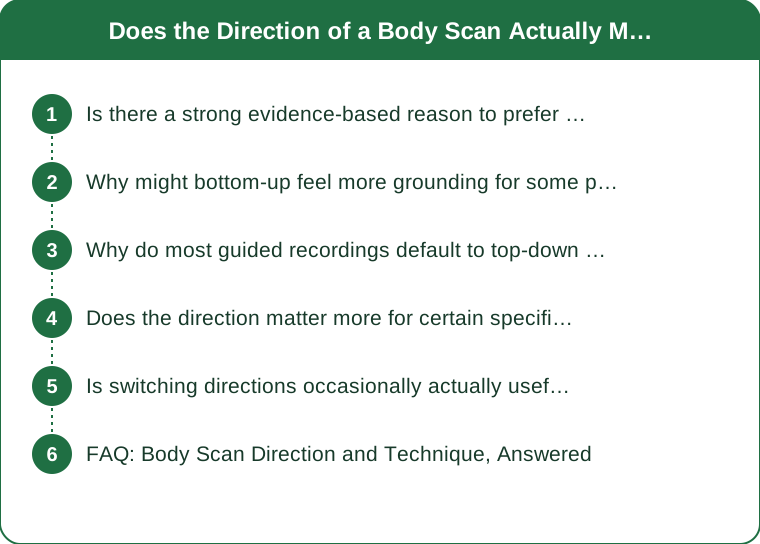
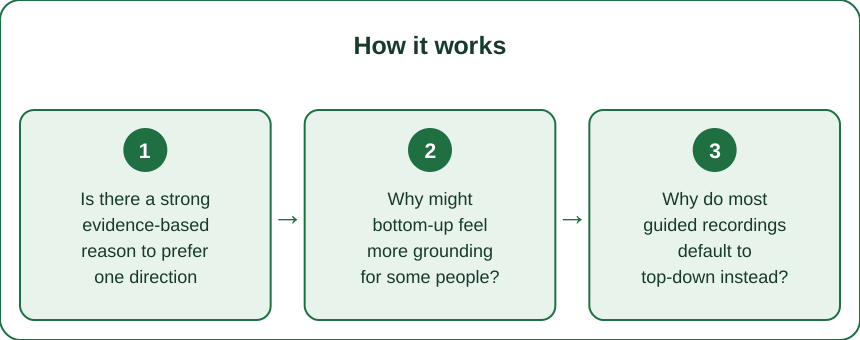
Is there a strong evidence-based reason to prefer one direction over the other?
Not a strong one — most of the research on body scan meditation focuses on the practice’s overall benefits for stress and awareness rather than comparing directional variants directly, so the top-down default seen in most guided recordings reflects convention and ease of instruction more than a proven superior outcome.
Why might bottom-up feel more grounding for some people?
Starting attention at the feet, in contact with the ground or bed, can create an immediate sense of physical stability before moving attention upward, which some practitioners find genuinely calming, especially if a lot of daily tension or racing thoughts tend to concentrate in the head and shoulders — starting away from that area first can ease into the practice more gently for that specific pattern.
Why do most guided recordings default to top-down instead?
Top-down tends to mirror the natural, familiar sequence of settling in — closing the eyes, becoming aware of the head and face relaxing, then working downward — which feels intuitive to teach and follow for beginners, and has simply become the more established convention as a result, independent of any strong claim that it works better.

Does the direction matter more for certain specific goals, like sleep versus stress relief?
For sleep-focused practice specifically, some people find a top-down scan pairs naturally with the physical process of settling into bed, while others doing body scans for tension relief during the day may prefer starting wherever they already feel the most noticeable tension, regardless of anatomical direction, to address the most pressing area first.
Is switching directions occasionally actually useful, or is consistency better?
There’s no strong reason consistency in direction is required for the practice to be effective — some practitioners intentionally vary direction to keep attention engaged rather than running through a memorized, semi-automatic sequence, which for some people maintains better present-moment awareness than always following the identical order.
FAQ: Body Scan Direction and Technique, Answered
Should a body scan always start with the whole body or a single point?
Starting with a single point of focus (often the feet or head, depending on direction chosen) rather than trying to sense the whole body at once is generally recommended for clearer, more effective practice regardless of which direction is used.
Does lying down versus sitting change how effective a body scan feels?
Lying down is more commonly recommended for body scans specifically since it removes the need to maintain postural muscle tension, letting the practice focus purely on sensation and release rather than balance.
Is it normal to fall asleep during a body scan regardless of direction?
Yes, especially when done lying down or before bed — for stress relief and sleep-focused practice this isn’t generally considered a failure of the technique, though for daytime focus practice it may be worth trying a seated position instead.
TL;DR:
- No strong evidence favors top-down or bottom-up direction over the other
- Top-down is the more common convention, largely for ease of teaching and habit
- Bottom-up can feel more grounding for people who hold tension in the head or shoulders
- Starting at the area with the most noticeable tension is a reasonable goal-based choice
- Varying direction occasionally can help maintain present-moment attention for some people
The direction that actually helps you settle in is the right one — there’s no single correct order.
Keep Reading
This article is for general informational purposes only and is not medical advice. Always consult a qualified health professional for guidance specific to you.