Why Body Scan Meditation Sometimes Makes You More Anxious, Not Calmer
Quick Answer: Body scans can increase anxiety when they direct sustained attention to areas already holding chronic tension without any accompanying release technique — noticing tension without a next step can amplify awareness of discomfort rather than resolve it. Pairing the scan with active release cues (breath, gentle movement) usually fixes this.
You expected to feel more relaxed by the end. Instead, focusing on your shoulders made you acutely aware of just how tight they’ve been for weeks, and that awareness itself felt uncomfortable rather than soothing.

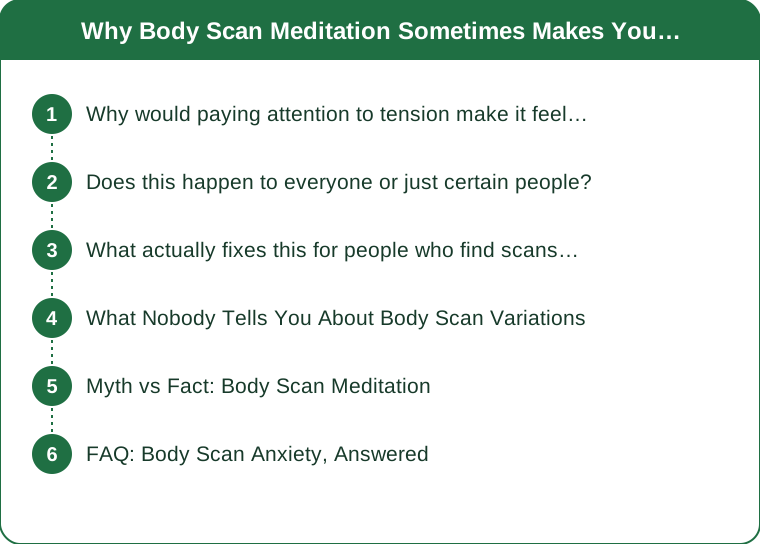
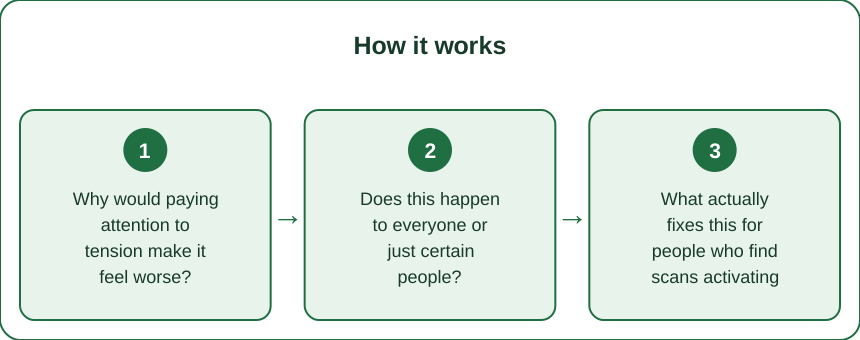
Why would paying attention to tension make it feel worse?
A pure noticing-only body scan asks you to observe sensation without directing what happens next, and for areas holding chronic, low-grade tension, that sustained attention can amplify the awareness of discomfort without providing any mechanism to actually release it. You end up more conscious of the tightness, with no built-in next step, which can register as increased overall discomfort rather than the intended calm.
Does this happen to everyone or just certain people?
It’s more common in people with higher baseline anxiety or a habit of catastrophizing physical sensations — noticing a tight chest, for someone prone to anxious interpretation, can trigger worry about what that tightness means rather than simply registering it neutrally. For people without that anxious interpretation pattern, pure noticing tends to work fine without needing modification.
What actually fixes this for people who find scans activating rather than calming?
Pair each area you notice with an active release cue rather than pure observation — as you scan to your shoulders, consciously drop them an inch on an exhale; as you scan your jaw, unclench it deliberately. This turns the practice from passive awareness (which can amplify discomfort) into active regulation (which gives the nervous system something concrete to do with the awareness).

What Nobody Tells You About Body Scan Variations
Here’s something rarely mentioned when body scans are recommended broadly: not all body scan scripts are equal — some guided versions include explicit release cues built in, while others are strictly observational, and the observational-only style is specifically the one more likely to activate rather than calm anxious practitioners. If a body scan has consistently backfired, the fix might simply be switching to a script that pairs noticing with release, rather than abandoning the practice entirely.
Myth vs Fact: Body Scan Meditation
Myth: Body scans are universally calming for everyone. Fact: Pure observational scans can increase anxiety for people prone to catastrophizing physical sensation.
Myth: If a body scan feels activating, meditation isn’t for you. Fact: Switching to a release-paired script, rather than pure observation, often resolves the issue entirely.
Myth: Noticing tension is inherently therapeutic on its own. Fact: Noticing without a release mechanism can amplify discomfort rather than reduce it.
FAQ: Body Scan Anxiety, Answered
How do I know if a guided body scan includes release cues?
Listen for instructions like ‘soften,’ ‘let go,’ or ‘release on the exhale’ paired with each body area — pure observational scripts stick to ‘notice’ language only.
Should I stop doing body scans if they make me more anxious?
Not necessarily — try a release-paired version first before concluding the technique itself doesn’t work for you.
Does starting with a shorter scan help if longer ones feel overwhelming?
Yes, a 5-minute release-paired scan is a reasonable starting point before working up to longer, fully observational practices.
TL;DR:
- Pure observational body scans can amplify awareness of chronic tension without resolving it, increasing anxiety for some
- This is more common in people prone to catastrophizing physical sensations
- Pairing each noticed area with an active release cue (breath, gentle movement) usually fixes the backfire
- Not all guided scripts are equal — some include release cues, others are strictly observational
Next time you try a body scan, add a deliberate release (soften, drop, exhale) at each area instead of just noticing it — that single change often turns an activating practice into a genuinely calming one.
Keep Reading
This article is for general informational purposes only and is not medical advice. Always consult a qualified health professional for guidance specific to you.