Why Your Hips Feel So Tight During Somatic Work (and What's Actually Happening)
Quick Answer: The hips involve some of the body’s largest muscle groups and are heavily activated during stress responses (bracing to run or freeze), so they tend to hold chronic tension patterns that surface noticeably once you slow down enough in somatic work to actually notice them.
You hear it in nearly every somatic or trauma-informed movement class: ‘the hips hold a lot.’ It sounds like a wellness cliche until you’re actually in a hip-opening pose and feel something that seems disproportionate to the physical stretch itself.

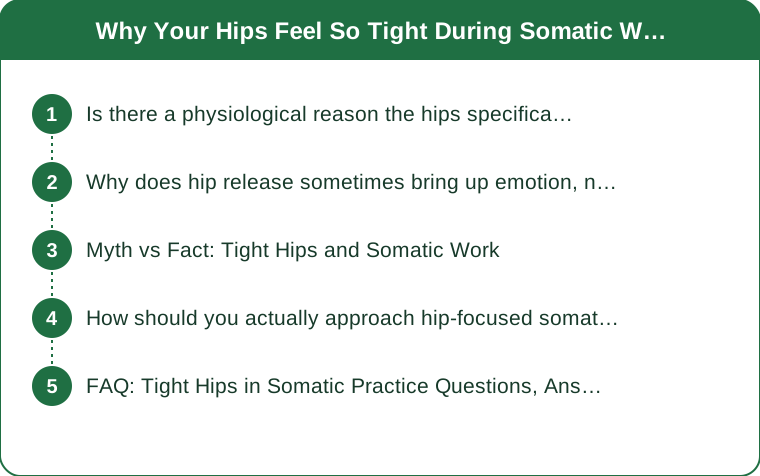
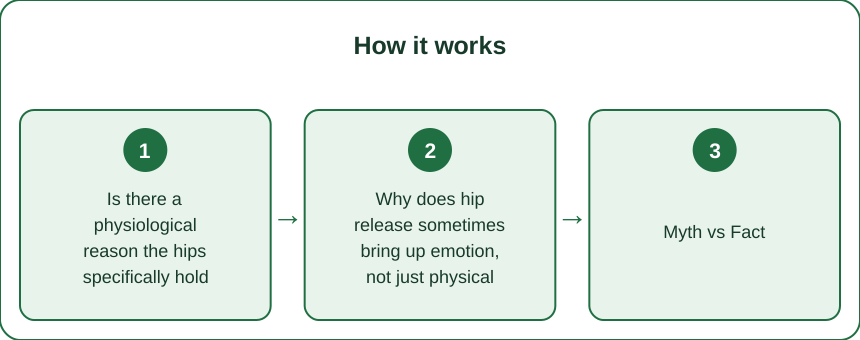
Is there a physiological reason the hips specifically hold tension?
The hip flexors, particularly the psoas muscle, connect the spine to the legs and are directly involved in the body’s stress response — specifically the muscles that engage when preparing to run, flee, or brace. In a body that’s spent a lot of time in chronic low-grade stress or a sedentary seated position (which shortens hip flexors regardless of stress levels), these muscles can hold ongoing tension without much conscious awareness.
Somatic work often involves slowing down and paying close attention to sensation in a way daily life rarely does, which is why tension that’s been present for a long time can suddenly feel very noticeable once you’re finally still and attentive enough to register it.
Why does hip release sometimes bring up emotion, not just physical release?
This is one of the more discussed phenomena in somatic and trauma-informed movement work — the idea that physical tension and emotional experience can be stored together, so releasing the physical holding pattern sometimes coincides with an emotional response like unexpected tearfulness. This isn’t universal or guaranteed, and it doesn’t happen for everyone, but it’s common enough that most somatic practitioners prepare clients for the possibility rather than treating it as unusual.
If this happens, it’s generally considered a normal part of the process within trauma-informed movement frameworks, not a sign something is wrong.

Myth vs Fact: Tight Hips and Somatic Work
Myth: Tight hips always mean unprocessed trauma. Fact: Hip tightness is extremely common simply from prolonged sitting and general stress, regardless of specific trauma history — it’s not a diagnostic sign on its own.
Myth: You have to push through discomfort for a hip release to be effective. Fact: Somatic approaches generally emphasize gentle, gradual movement — forcing a stretch tends to trigger more guarding and resistance, not less.
Myth: If you don’t feel an emotional release, the practice isn’t working. Fact: Purely physical relief without any emotional component is a completely normal and valid outcome — emotional release isn’t a required marker of progress.
How should you actually approach hip-focused somatic movement if it feels intense?
Go slower than feels necessary, and give yourself permission to stop or back off the intensity of a stretch at any point — somatic work generally isn’t about pushing to a maximum range of motion, it’s about staying present with whatever sensation shows up. If something feels emotionally intense, pausing to simply breathe in that position, rather than moving deeper or immediately exiting the position, is a commonly recommended approach.
If hip tension or emotional responses during movement feel consistently overwhelming, working with a trained somatic or trauma-informed practitioner rather than a self-guided routine is a reasonable next step. This is general information, not medical or mental health advice.
FAQ: Tight Hips in Somatic Practice Questions, Answered
Is it normal to cry during hip-opening somatic exercises?
It happens for some people and is generally considered a normal part of the process within trauma-informed movement work, though it’s not universal or required for the practice to be beneficial.
Why do my hips feel tighter on stressful days specifically?
The hip flexors are involved in the body’s physical stress response, so days with more accumulated stress can plausibly correlate with more noticeable tension in that area.
Should I push through tight hips or ease off during somatic movement?
Generally ease off — somatic approaches favor gentle, attentive movement over pushing to a maximum stretch, since forcing it tends to increase guarding rather than release it.
TL;DR:
- Hip flexors, especially the psoas, are directly tied to the body’s physical stress response
- Sitting and general stress both contribute to chronic hip tension, not just specific trauma
- Emotional responses during hip release are common but not required or universal
- Move gently and slowly rather than pushing for maximum stretch intensity
Whatever comes up during hip-focused somatic work, physical or emotional or neither, is a valid outcome. This is general information, not medical or mental health advice.
Keep Reading
This article is for general informational purposes only and is not medical advice. Always consult a qualified health professional for guidance specific to you.