Why Shaking After Stress Is Your Body Finishing the Job
Quick Answer: Post stress trembling is your nervous system unwinding a mobilization it no longer needs. Stress chemistry primed the muscles for action; when the moment passes, the surplus activation leaves — and shaking is one of the ways it leaves. Mammals do this openly after every chase; humans learned to suppress it as embarrassing, which leaves the activation to drain slowly as tension instead. Somatic approaches treat the tremble as something to permit and even invite deliberately, in a safe setting, rather than to clamp down. New, persistent, or unexplained tremor is a different thing entirely and belongs with a doctor.
The shake is not the system breaking. It is the system closing the loop.

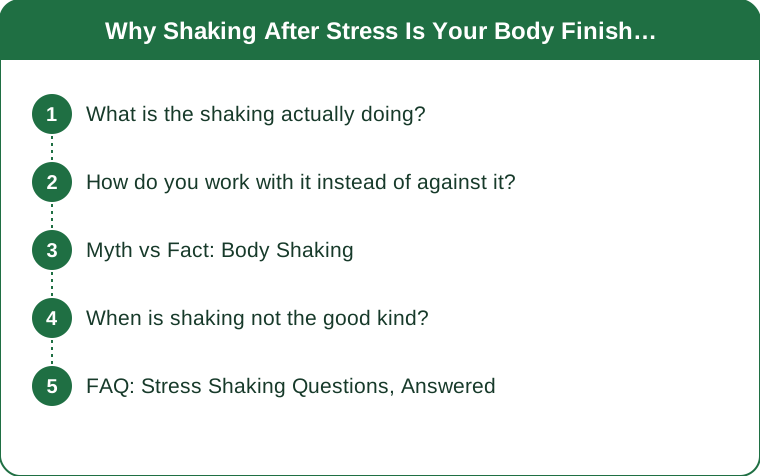
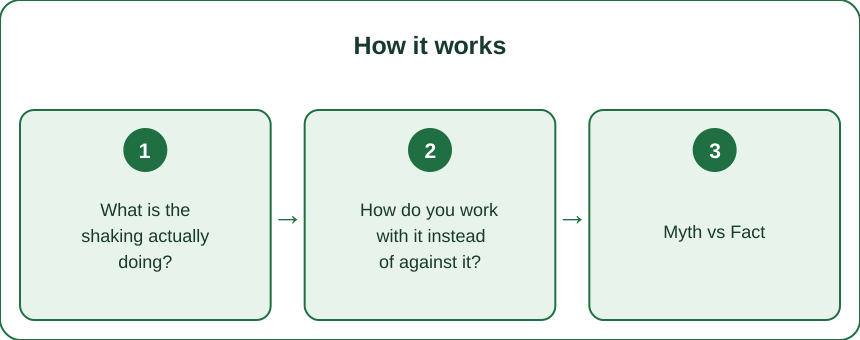
What is the shaking actually doing?
Completing a stress cycle that got you ready for an action that never fully happened.
When your system reads threat — a swerve on the highway, a phone call that starts with bad news, a confrontation — it mobilizes hard and fast. Adrenaline surges, muscles pre tension for action, blood shifts toward the big movers. That energy is a loan against an emergency: fight, run, brace.
Then the emergency resolves in forty seconds, and you are left standing in your kitchen fully fueled for a sprint that is not happening. The tremble is one of the body’s exit ramps for that surplus — muscles discharging their braced state, the chemistry burning off, the system stepping down from red alert. Watch any nature documentary and you can see the unedited version: an animal that survives a chase often shakes visibly for a minute and then walks off grazing, done. The event ends and the activation ends with it.
Humans add a complication: we experience the tremble as socially humiliating, so we clamp it — jaw set, muscles stiffened, hands gripped still. The suppression works, in the sense that the visible shaking stops. But the activation did not vanish because we hid it; it drains slowly instead, and that slow drain is a decent description of the shoulders that stay up all evening and the wired-but-exhausted feeling after a hard day.
This is the insight somatic practitioners build on: the tremble is not the problem, it is the resolution — and treating it as safe changes what your body does with the next stressful hour.
How do you work with it instead of against it?
Permit it in the moment when you safely can, and practice the deliberate version so the pathway stays open.
In the moment: stop performing stillness. If the meeting is over, the car is parked, the call has ended — let the hands tremble, let the legs be unsteady, breathe with long slow exhales, and give it a minute or two instead of immediately gripping a countertop and announcing you are fine. Ground afterward: feel your feet, look around the room, name where you are. The sequence is discharge, then settle.
The deliberate practice is simpler than it sounds. Somatic shaking as an exercise: stand with soft knees, start a gentle bounce through the heels, and let the looseness travel — arms floppy, shoulders loose, jaw unclenched — for two to five minutes, then stand still and notice the settling. It looks silly, which is partly the point; silliness and bracing cannot coexist.
TRE — tension and trauma releasing exercises — is the structured version, using a sequence of postures to fatigue the legs until a natural tremor starts, then letting it run while lying down. It is popular for a reason, and for anyone with significant trauma history, it belongs with a trained practitioner rather than a video, because releases can bring up more than expected.
End with downshift, not more charge. A few minutes lying with legs up a wall, slow nasal breathing with extended exhales, or simply lying still turns the discharge into actual calm.
And notice where you already know this: the trembling in the last seconds of a hard plank, the quivering legs after heavy squats. Part of that is simple muscle fatigue — but the ease with letting muscles shake without alarm is the exact skill, already installed.

Myth vs Fact: Body Shaking
Myth: shaking means the panic is getting worse. Fact: trembling often marks the downhill side of a stress response — mobilization leaving, not building. Reading it as escalation creates fear of the recovery itself, which is the actual spiral. Reading it as discharge lets it finish.
Myth: this is only relevant for people with major trauma. Fact: the mobilization discharge cycle runs in every nervous system for every scale of stress — a near miss in traffic, a presentation, an argument. Trauma work is one application of the principle, not the boundary of it.
Myth: you must shake to release stress properly. Fact: it is one exit ramp among several. Exhale led breathing, hard exercise, crying, laughing, a brisk walk — all discharge activation. Shaking is notable because it is fast and built in, not because it is mandatory.
Myth: more intense shaking equals deeper release. Fact: intensity is not the metric — completion is. A gentle tremble that runs its course and settles does the job; chasing bigger shakes is theater, and in trauma work it can be destabilizing. Gentle and finished beats dramatic and forced.
Myth: shivering when cold is the same thing. Fact: cold shivering is thermoregulation — muscles generating heat — and stress trembling is discharge. They share hardware, which is why they look alike, but a shiver on a cold morning needs a layer, not a somatic practice.
Myth: trembling in a workout means stop immediately. Fact: end range muscle quiver under fatigue is normal and safe to ride briefly. The signal to respect is form collapse — shaking plus breakdown means the set is over.
When is shaking not the good kind?
When it shows up without a stress story, will not resolve, or comes with other changes — and it is worth being plain about the line.
See a doctor about tremor that is new and persistent, happens at rest without any stressful trigger, worsens over weeks, runs on one side, or arrives with other symptoms — changes in handwriting, stiffness, dizziness, weakness, or after starting a new medication. Caffeine excess, low blood sugar, thyroid issues, and several medications all produce trembling too, and all are worth ruling out rather than reframing. Somatic ideas are for the trembling that follows stress and resolves; everything else deserves medical eyes first. And for anyone with a significant trauma history, deliberate release work is genuinely better with a trauma informed practitioner in the room.
With that boundary drawn, a few practical notes for the season this lands in:
The fall schedule spike is material. September brings compressed mornings, new commutes, performance season at work — more mobilizations per day, more surplus to discharge by evening. A two minute shake practice between the workday and the evening — literally in the hallway after the laptop closes — is the cheapest transition ritual there is.
Dress for the floor time. The settle phase lives on the ground, and it works better when nothing digs in — soft layers, yoga pants or buttery-soft leggings rather than anything with a waistband that argues, warm socks as the evenings cool.
And as real cold arrives in a couple of months, remember the shiver distinction: trembling on a cold morning walk is thermostat, not psyche. The somatic version announces itself by context — it follows the hard conversation, not the temperature.
FAQ: Stress Shaking Questions, Answered
Is it okay to just suppress it in public?
Yes — clamping the tremble in the meeting is a reasonable social call, not damage. The move is to give the discharge its minute later, in private, rather than suppressing and then never unsuppressing. Think postponed, not cancelled.
How long should post stress trembling last?
Typically seconds to a few minutes, tapering as the system settles. Trembling that continues for hours, recurs without triggers, or comes with feeling unwell is doctor territory rather than discharge.
Why do I shake after the danger has completely passed?
Because the chemistry outlives the moment — the mobilization was built for minutes of action and the event took twenty seconds. The after shake is the system spending down the unused balance, which is precisely why it feels mistimed.
Can deliberate shaking help with everyday anxiety?
Many people find a short daily practice takes the edge off accumulated tension, and the risk profile of two minutes of gentle bouncing is about as low as wellness practices get. It complements rather than replaces the proven anchors — sleep, movement, and actual treatment when anxiety is running the show.
TL;DR:
- Stress mobilizes muscles and chemistry for action, and trembling is one of the body’s built in ways of discharging the surplus when the moment passes.
- Mammals shake openly and finish the cycle; humans suppress it as embarrassing and drain slowly as tension instead.
- Permit the tremble when safe, ground afterward, and use short deliberate shaking or TRE style practice to keep the exit ramp open — with a practitioner if trauma history is significant.
- New, persistent, one sided, or symptom accompanied tremor is medical, not somatic — rule out first, reframe second.
Next time the hard call ends and your hands are trembling, put the coffee down and let them, for one full minute. Then notice what your shoulders do.
See It in Motion
Seen here: Super High Waist Embossed Yoga Leggings with Inner Pocket — shop it on bubblelime.com
Keep Reading
This article is for general informational purposes only and is not medical advice. Always consult a qualified health professional for guidance specific to you.