Why the Same Somatic Exercise Feels Completely Different Standing Up
Quick Answer: Lying down removes the postural work of holding yourself up, which frees up attention and lets subtle internal sensation come forward. Standing, a large amount of your nervous system’s capacity is committed to balance, so the same movement produces far less noticeable sensation. Neither position is better - they train different things. Use lying down to find a sensation, and standing to make it usable in real life.
The floor is not a shortcut.
It is a quieter room to listen in.

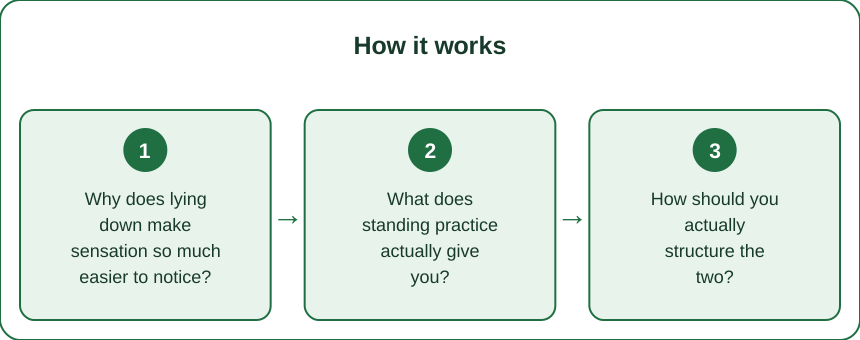
Why does lying down make sensation so much easier to notice?
Because it removes competing demands, and internal sensation is quiet by comparison.
Standing requires continuous postural control. Your body makes constant small adjustments through the ankles, hips, and trunk to stay upright, and that process consumes real attention even though it feels automatic. Lying down switches most of it off.
Contact with the floor gives you a reference surface. Sensation is easier to detect against a stable background, and the floor provides a consistent one - which is why you can feel which side of your back is heavier lying down and not standing.
Muscle tone drops when weight is supported. With less baseline tension, small changes are proportionally larger and therefore easier to notice. The same release is a bigger percentage change in a relaxed muscle.
Balance-related vigilance falls away. Even in complete safety, standing involves a low level of readiness that lying down does not. That drop in vigilance is a large part of why floor practice feels calmer, independent of the movement itself.
And breathing changes. Lying down alters how the diaphragm and ribs move, which most people experience as breathing feeling easier and deeper - and breath is often the thing being attended to.
So the floor is not producing a deeper release. It is producing a quieter background against which an ordinary release is finally audible.
What does standing practice actually give you?
Transfer - the thing floor practice on its own does not reliably produce.
Your problems happen standing. Tension builds at a desk, in a queue, carrying bags, walking. A release that only exists lying on a mat has not yet met the situation it needs to change.
Standing integrates the pattern into a loaded system. A shoulder that softens under no load may re-tighten the moment it has to support weight. Practising in the loaded position is what teaches the nervous system to keep the new pattern when it matters.
Balance work is part of the benefit, not an obstacle. Attention to subtle sensation while managing upright posture is a harder and more useful skill, and it improves with practice.
It is also far more available. Standing practice fits into a kitchen, an office, a train platform. A practice that requires floor space and privacy will happen a few times a week; one that needs neither can happen daily.
And the feedback is more honest. Standing shows you asymmetries - weight through one leg, one shoulder higher - that lying down conceals by supporting everything.
The practical sequence is: find it lying down, then reproduce it standing. Trying to find a subtle sensation for the first time while standing is unnecessarily hard, and it is why beginners often conclude somatic work does nothing.

How should you actually structure the two?
Lying down to learn, standing to apply, with a deliberate bridge between them.
Learn any new movement lying down first. Give it a few sessions until the sensation is clear and repeatable. You cannot transfer something you have not located.
Then use side-lying or seated as the intermediate step. These positions add some postural demand without the full balance requirement, and they are the missing rung most people skip.
Then stand with support before standing free. A hand on a wall or a chair back removes most of the balance load while keeping the upright orientation. This is where most of the transfer actually happens.
Then stand unsupported, and expect it to feel smaller. It will. A standing version that feels like ten percent of the floor version is working correctly - that is the sensation level available in real life.
Do the standing version in real conditions on purpose. While the kettle boils, waiting for a lift, at your desk. The context is the point - a release that only happens in a quiet room has not transferred.
And go back to the floor when something stops making sense. A movement that has become vague standing usually needs one session lying down to re-locate. The two positions are a loop, not a ladder.
What Nobody Tells You About Position and Somatic Work
Falling asleep during floor practice is extremely common and it is not a success. The relaxation is real, but the learning requires staying present. If you consistently fall asleep, practise sitting or standing - or move the session away from bedtime.
Standing practice reveals side-to-side differences that lying down hides. Most people stand with more weight through one leg without ever noticing. Standing work is where that becomes obvious, which is often uncomfortable and always useful.
Cold rooms change everything. Muscle tone rises in the cold, sensation is duller, and small movements feel less available. A practice that stops working in October may simply need a warmer room rather than a new approach.
Time of day matters more than people expect. Tissue is stiffer and sensation different in the morning than in the evening, and comparing a morning standing session to an evening floor session tells you almost nothing.
Standing after floor work is where people feel the effect most. The change is often not felt during the practice but in the first minute of standing up. Stand up slowly and pay attention - that transition is the most informative thirty seconds of the session.
And the feeling of nothing happening is not the same as nothing happening. The nervous system adjusts below the level of noticeable sensation, which is exactly why a session that felt uneventful can be followed by an afternoon that goes differently.
This is general wellbeing information, not medical advice. Persistent pain, dizziness, or new neurological symptoms should be assessed by a professional rather than worked through in a practice.
FAQ: Somatic Position Questions, Answered
Is lying down better for beginners?
Yes, for learning. A beginner needs to locate the sensation first, and the floor is the easiest place to do that. But staying exclusively on the floor is why some people practise for months without noticing any change in daily life.
Why do I feel nothing standing even after weeks on the floor?
Most likely because the standing version is genuinely subtler, and you are comparing it to the floor version. Add the intermediate steps - seated, then standing with a hand on a wall - and expect the standing sensation to be much smaller rather than absent.
Should I close my eyes when practising standing?
Only once you are steady, and only somewhere safe. Closing your eyes removes a major balance input and increases postural demand substantially, which raises the challenge but also amplifies the internal signal for people who are already stable.
TL;DR:
- Lying down frees the attention that standing spends on balance, which is why floor practice feels more vivid.
- Standing is where transfer happens - your tension builds upright, so the change has to be learned upright.
- Sequence it: lying, seated, standing with support, standing free - the intermediate steps are the ones people skip.
- Expect the standing version to feel much smaller. That is the sensation level available in real life.
- Falling asleep on the floor is not progress, and a cold room genuinely mutes the whole practice.
This week, do your usual floor practice and then repeat it standing at the kitchen counter. The gap between the two is the actual work.
Keep Reading
This article is for general informational purposes only and is not medical advice. Always consult a qualified health professional for guidance specific to you.