Why Somatic Work Feels Easier Lying Down Than Sitting Up
Quick Answer: Lying down removes the continuous postural work of holding yourself upright, which frees attention for interoception — noticing internal sensation. It also increases ground contact and vagal tone, both of which support the settled state somatic work depends on. Sitting is not worse, it is harder, and it is the version that transfers to daily life. Build the skill lying down, then deliberately practise it seated so you can use it at a desk.
On the floor, ten minutes and you are somewhere different.
In a chair, ten minutes and you have mostly thought about your inbox.
The practice is the same. The position is doing a lot of work.

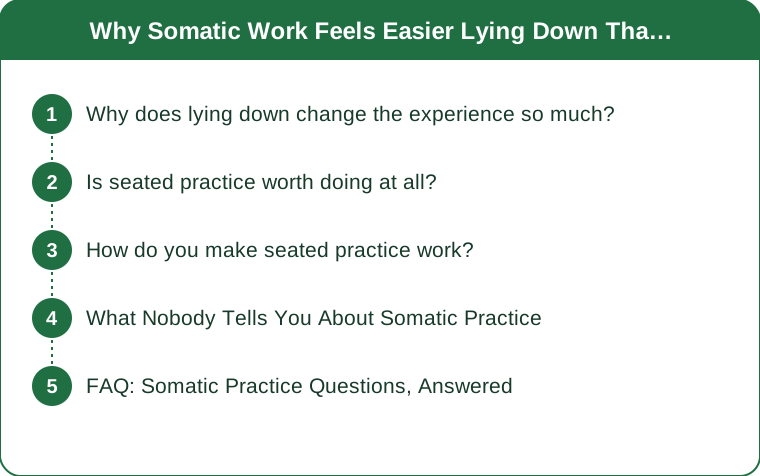
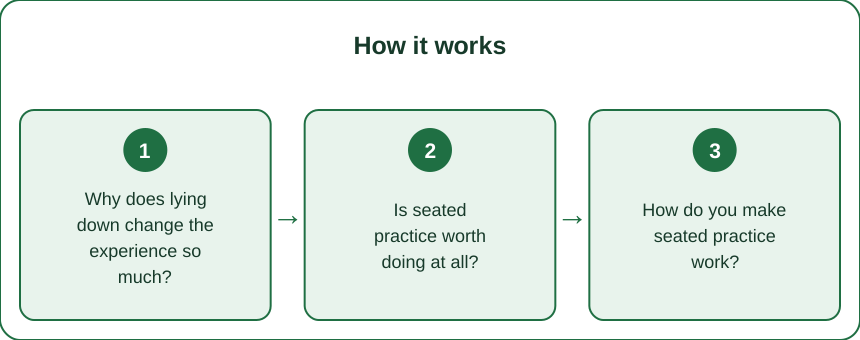
Why does lying down change the experience so much?
Four reasons, and the first is the largest.
Postural muscles switch off. Sitting upright is continuous low-level muscular work in the trunk, neck and hips. That work occupies part of your attention and your nervous system permanently. Lying down releases it, and the freed capacity goes to noticing.
Interoception competes with everything else. Sensing internal signals — breath, heartbeat, tension, temperature — is a limited-capacity process. Remove postural demand and there is simply more available for it.
Ground contact provides more sensory information. Supine, a large area of your body is in contact with a surface. That broad, even pressure gives your nervous system a lot of reassuring input, and it makes body-scanning easier because there is more to feel.
Vagal tone tends to be higher when supine. Being horizontal supports parasympathetic activity — the branch associated with rest and settling — which is the state somatic practice both requires and cultivates.
And there is a learned association. Lying down means sleep, rest and safety. That association is doing real work before you begin.
Which means seated practice is not failing. It is a harder version of the same skill, and it feels less dramatic for structural reasons rather than because you are doing it wrong.
Is seated practice worth doing at all?
Yes — and for daily life it is the more valuable one.
You need it where you actually are. Regulation is most useful mid-day, at a desk, in a car, before a difficult conversation. Lying on the floor is rarely available at those moments.
It builds a more portable skill. Practising interoception with postural demand present teaches you to find internal sensation while doing something else, which is what real use looks like.
It transfers better into movement. If you want somatic awareness while walking, lifting or standing in a queue, seated practice is the bridge.
Alertness is genuinely higher. Lying down slides toward sleep for many people, especially in the evening. Seated practice stays awake, which matters if you are working with something that needs your attention.
It suits some bodies better. For anyone with reflux, back pain in supine, late pregnancy or breathing difficulty, sitting is more comfortable and more sustainable.
The sensible approach is both. Learn the sensations lying down where they are clearest, then deliberately look for those same sensations seated, where they are quieter.

How do you make seated practice work?
Six adjustments that close most of the gap.
Get proper support. Feet flat on the floor, sitting bones on a firm surface, back supported if that helps. Any effort spent holding yourself up is effort not spent noticing.
Start with contact points rather than the whole body. Feet on floor, sitting bones on chair, hands on thighs, back on chair. Four clear points of contact give you something concrete to feel, which is what lying down provides automatically.
Shorten the practice. 5 to 8 minutes seated, rather than the 20 minutes you might do lying down. Sustained interoception with postural load is more demanding, and a shorter successful practice beats a longer scattered one.
Use breath as the anchor, not a body scan. Scanning a whole body is harder seated. Following the movement of breath at one location — belly, ribs, or nostrils — is more achievable.
Add gentle movement. Small pelvic tilts, slow shoulder rolls, a slight sway. Movement generates sensation, and sensation is what you are trying to notice. Stillness is the advanced version, not the entry point.
Practise at the same time each day. Seated practice benefits more from routine than lying-down practice does, because it lacks the strong environmental cue that getting on the floor provides.
This is general information, not medical or psychological advice.
What Nobody Tells You About Somatic Practice
Feeling nothing is a stage, not a failure. Interoceptive awareness is a trainable skill with a real learning curve. People who feel very little at first often develop clear awareness over six to eight weeks of regular short practice.
Position changes the experience more than technique does. People switch methods repeatedly looking for the one that works, when moving from a chair to the floor would have answered it.
Emotions surfacing is common and normal. Reduced muscular guarding often lets feeling through. It is expected. If it becomes overwhelming or connects to trauma, that is the point to work with a trained professional rather than alone.
More is not better. 10 minutes daily outperforms an hour on Sunday by a wide margin, because this is a skill being trained rather than a treatment being administered.
Time of day changes it noticeably. Morning practice tends to be alert and clear; evening practice tends to be softer and slides toward sleep. Neither is correct — they are different tools.
And the practical one: temperature matters more than people expect. Lying still lowers your body temperature quickly, and being slightly cold shifts you toward alertness and away from settling. A blanket is not an indulgence; on a cool autumn evening it is the difference between a practice that works and one that does not.
FAQ: Somatic Practice Questions, Answered
Is lying down better than sitting?
Easier, not better. Lying down makes sensation clearer; seated practice builds the skill you can actually use during the day. Do both.
How long should a session be?
10 to 20 minutes lying down, 5 to 8 minutes seated. Daily consistency matters far more than length.
What if I keep falling asleep?
Common when supine, especially in the evening. Try knees bent, eyes slightly open, morning practice, or switching to seated.
What if I do not feel anything?
Normal early on. Start with contact points and breath rather than subtle internal sensation, and give it six to eight weeks of short daily practice.
Why do emotions come up?
Reduced muscular guarding often allows feeling to surface. It is a common and expected response. Seek professional support if it becomes overwhelming.
Best time of day?
Morning for alertness and clarity, evening for settling. Pick based on what you want from it rather than on which is correct.
Can I do this at my desk?
Yes — that is the main argument for seated practice. Feet flat, contact points, three minutes of following the breath. It is deliberately unremarkable to anyone watching.
TL;DR:
- Lying down removes continuous postural work, freeing attention for interoception.
- Broad ground contact and higher vagal tone make sensation clearer supine.
- Seated practice is harder, not worse — and it is the version that transfers to daily life.
- Seated: use contact points and breath, keep it to 5 to 8 minutes, add gentle movement.
- Feeling nothing at first is a stage; expect six to eight weeks of short daily practice.
Learn it lying down this week, then try five minutes of the same thing in your desk chair. The gap between the two is the skill you are building.
Keep Reading
This article is for general informational purposes only and is not medical advice. Always consult a qualified health professional for guidance specific to you.