Why Somatic Work Lands Differently After a Bad Nights Sleep
Quick Answer: Poor sleep leaves the nervous system in a more activated, less regulated state - stress hormones run higher, sensory thresholds shift, and interoception becomes less reliable. The same practice therefore starts from a different baseline. Slow scanning practices that normally settle you can amplify agitation when you are exhausted, while movement-based practices usually still work. The fix is switching practice type, not trying harder at the same one.
Here is what changes and what to do instead on those days.

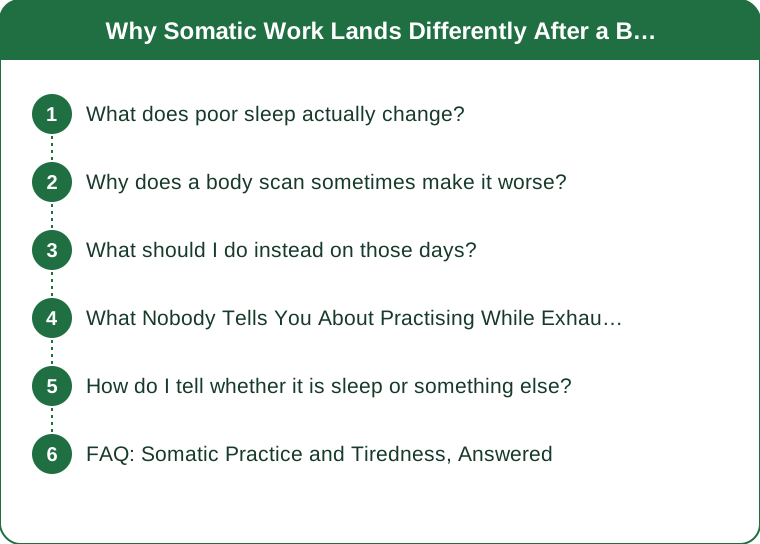
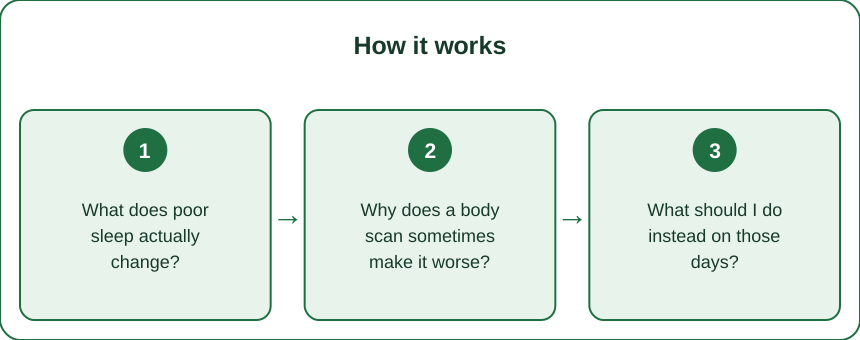
What does poor sleep actually change?
Sympathetic activity runs higher after a short night. Sleep deprivation is associated with raised cortisol later in the day and increased sympathetic tone, so you begin the practice already further from a settled state.
Sensory thresholds shift. Tired nervous systems tend to register sensation as more intense - sounds louder, discomfort sharper, restlessness more insistent. A body scan that was neutral becomes a scan of things that now feel like problems.
Interoception - your sense of internal state - becomes less reliable. Reading what is happening inside your body requires the same attentional resources that sleep loss depletes. So the signal you are trying to observe is noisier.
Emotional regulation is measurably weaker. Sleep loss consistently reduces the capacity to regulate emotional responses, which is why a practice that occasionally brings up feeling can bring up much more when you are exhausted.
And stillness is harder to hold. A tired body often produces restlessness rather than relaxation, which is the opposite of what people expect - and why lying still can feel intolerable on exactly the days you most want it to help.
Why does a body scan sometimes make it worse?
Because a scan directs attention toward sensation, and tired sensation is amplified. Turning attention to a body that is registering everything more intensely can increase discomfort rather than reduce it.
Slow practices leave room that a tired mind fills. With less to attend to, rumination has space - and a sleep-deprived brain ruminates more readily. This is the most common mechanism behind a scan feeling agitating.
Lying still invites sleep pressure, then frustration. You are tired enough to doze but trying to stay aware. Fighting that produces its own tension, and people often finish more wound up than they started.
The threshold for uncomfortable sensation is lower. Areas that normally register as neutral tightness register as pain or urgency, and the practice becomes a survey of complaints.
And expecting it to fix the tiredness sets it up to fail. Somatic practice does not replace sleep. When it is used as a substitute for rest, it disappoints - and that disappointment reads as the practice not working.
What should I do instead on those days?
Switch to movement rather than stillness. Gentle rhythmic movement - slow rocking, spinal waves, shaking, or simply walking with attention - gives the tired nervous system something to organise around. This is the single most useful adjustment.
Shorten it substantially. Three to five minutes rather than twenty. A short practice that lands beats a long one that agitates, and on low-sleep days the shorter version is often more effective, not less.
Use external anchors rather than internal ones. Attention on the feel of the floor, the sound of the room, or the weight of a blanket is easier to hold than attention on subtle internal sensation when interoception is unreliable.
Add weight and containment. A weighted blanket, a firm wall to lean against, or a supported position with props provides steady external input, which many people find more settling than open awareness when tired.
Prioritise the exhale. Making the out-breath longer than the in-breath - for example four in, six out, for two minutes - is one of the few reliably down-regulating tools that still works on a depleted system.
And do it earlier in the day. On low-sleep days, evening practice tends to collide with the point of lowest regulation. Morning or midday lands better, even if the session is shorter.

What Nobody Tells You About Practising While Exhausted
Falling asleep during practice is fine and is not a failure. If your body takes the rest, it needed the rest more than it needed the practice. The framing that this is a lapse in attention is unhelpful and widespread.
Consistency matters more than quality on bad days. A three-minute version that keeps the habit alive is worth more than skipping until you feel able to do it properly - because the habit is what carries you across bad weeks.
Emotional surfacing is more likely, not less. Reduced regulation capacity means feelings arrive more readily. That is not a sign of progress or of damage - it is a predictable effect of being tired, and it usually passes with sleep.
Cold rooms make it much harder. As autumn arrives, a cool room plus a tired body produces guarding and restlessness rather than settling. Warmth matters more when you are exhausted than at any other time - a blanket is not optional.
Caffeine timing interacts more than people expect. A tired day usually involves more coffee, later. Practising two hours after a large afternoon coffee is a different physiological situation and it is worth noticing before blaming the practice.
And a run of bad nights is a signal, not a practice problem. Persistent poor sleep affects mood, cognition, and health, and no amount of somatic work substitutes for addressing it. If it has gone on for weeks, that is worth a professional conversation. This is general information, not medical advice.
How do I tell whether it is sleep or something else?
Track two numbers for two weeks: hours slept, and how the session felt on a simple 1 to 5 scale. The pattern usually becomes obvious within a fortnight and removes the guesswork.
Look for the dose relationship. If sessions after six hours or less are consistently worse and sessions after seven or more are consistently better, sleep is the variable and you can plan around it.
Check what else moves with it. Alcohol, caffeine, illness, hormonal cycle, and a cold room all affect how practice lands. Sleep is often the largest but rarely the only factor.
Notice which practices are robust. Most people find one or two that work regardless of state - usually movement-based or breath-based ones. Knowing yours is genuinely useful, because it is what you use on the bad days.
Do not judge a practice on one bad session. Any single session is affected by too many variables. Judge over two or three weeks, and preferably against the tracked numbers rather than memory.
And be clear about the limits. Somatic practice can help with the experience of being tired; it cannot replace sleep, and treating it as if it can guarantees disappointment. Persistent insomnia, or exhaustion that does not improve with rest, needs medical input rather than a better practice. This is general information, not medical advice.
FAQ: Somatic Practice and Tiredness, Answered
Why does a body scan feel agitating when I am tired?
Tired nervous systems amplify sensation and ruminate more readily. Directing attention inward toward an amplified signal, in a practice with lots of open space, can increase discomfort rather than reduce it.
Should I skip practice after a bad night?
No - switch type and shorten it. Gentle movement, breath with a longer exhale, or a weighted supported rest for three to five minutes usually works when stillness does not.
Is falling asleep during practice a problem?
No. If your body takes the rest, it needed it. Treating that as a failure of attention is a common and unhelpful framing.
Why do emotions come up more when I am exhausted?
Sleep loss reduces emotional regulation capacity, so feelings arrive more readily. It is a predictable effect of tiredness and usually settles once sleep does.
What is the most reliable practice on a low-sleep day?
Extending the exhale - four counts in, six out, for a couple of minutes - and gentle rhythmic movement. Both work on a depleted system when scanning practices do not.
Can somatic work replace lost sleep?
No. It can change how the tiredness feels, but it does not substitute for sleep. Expecting it to is the main reason people conclude it stopped working.
When should I get help with the sleep itself?
If poor sleep has persisted for several weeks, or if exhaustion is not improving with rest, that is worth raising with a doctor rather than managing with practice alone.
TL;DR:
- Poor sleep raises sympathetic activity, amplifies sensation, and makes interoception less reliable. The practice starts from a different baseline.
- Stillness and scanning are the practices most likely to backfire when tired - amplified sensation plus open space for rumination.
- Switch to movement, breath, or supported rest. Gentle rhythmic movement gives a tired system something to organise around.
- Shorten to three to five minutes and move it earlier in the day.
- Extend the exhale - four in, six out - it is one of the few reliably down-regulating tools that still works when depleted.
- Warmth matters more than usual. A cool autumn room plus exhaustion produces guarding, not settling.
- Falling asleep is not a failure, and emotional surfacing when tired is predictable rather than meaningful.
Somatic work cannot replace sleep. Weeks of poor sleep need a professional conversation. This is general information, not medical advice.
Keep Reading
This article is for general informational purposes only and is not medical advice. Always consult a qualified health professional for guidance specific to you.